Star Wars kinda soured on me in the early 00’s. Yeah, the prequels sucked, but even worse for me was the explosion of fandom and extended universe what-nots. From release of the first movie up until around the time the special editions came out, Star Wars was limited and distilled down mostly to those first three movies. Any trickle of new content was a joy and this soundtrack felt special. It was like being able to watch the film anywhere as scenes would replay in my mind with every musical passage. But now, with the marketing deluge, even the most minor tracks on this CD feel like I’m watching a Taco Bell commercial. Trying to hear past that, I can say that the music is pretty incredible in the way it tells the story and defines the characters (even though it is very much a reworking of Gustav Holst’s “The Planets”).

I wasn’t sure if he was supposed to be a good guy, but the title character is a swordsman whose calling card is that he breaks of a piece of his sword in the bodies of his foes. You would think by the end of the movie he would be wielding a nub, but the sword never seems to shrink much. The plot is more complicated than most kung-fu pictures and includes a gambling house where dominoes is the game of choice, weird freeze-frame fight moments, a “killer” doctor, and an archetypal annoying jokester hero.
This was a decent martial arts film notable for four things: a snowy, wintertime setting; exciting fights with many, many combatants; whip fighting; and Cheng Pei Pei commanding the screen in a modified Santa Claus suit.
This is a weird one. It starts off with a display of magical cloaked fighters in which two are made to kill themselves. One fighter (who I swear is a young Jackie Chan) gouges out his eyes, the other gouges out his, um… crotch. You are then shown more magical legions; the first is using voodoo power and the other is trying to block gun shots with a combination of muscle flexing and paper. The set up is crazy and you know it’s going to be great, but then it hits the breaks and focuses on an old man who can lift lots of wood. After some time the action returns with a couple of excellent sequences in which three assassins are trying to secretly take out the old guy, an out-of-place fight in which a jokester pretends to be a magical fighter, and another in which said jokester fights in a latrine controlled by voodoo. When we finally get around to the big display of the eighteen legendary weapons it’s pretty anticlimactic and boring.

This is what the kids call a metroidvania-style platformer (what a horrible term). You run around around a large, open-world and gain access to new areas as you upgrade to new powers. I tried to play Super Metroid on the Wii, but I don’t think I had the patience for that older game. Guacamelee! on the other hand was very accessible. The movement is fast and fluid with easy fighting mechanics. The vector art style is really pretty and colorful, but the music is a bit repetitive. The story tries to be funny in that unfunny way that 90% of games attempt humor. There is also this dimension shifting power taken straight from Giana Sisters: Twisted Dreams that is just annoying in this context. Thankfully, the game has enough good mechanics to make up for that one bad one and offers lots of reward for exploration and a genuine feeling that you are getting better as you progress through the game.

By 1994, having become bored with most of indie rock I had been listening to as a college student, I had immersed myself into surf rock. I remember sitting in the theater watching Pulp Fiction on opening weekend and being thrilled by all the surf instros I recognized. Really there are only about 4 surf tracks here but it sure felt like more. Even so, this soundtrack was largely responsible for the great garage/surf boom of the 90’s (and the subsequent surf crash of ’97). Although the rest of the record is not really my cup of pizza, there is plenty of dialogue interspersed to make this a good listen from beginning to end.
I’ve written before on this Web site how there is a standard documentary being produced these days that shows the “community” that has grown around various niche topics. Find a bunch of nerds who like the same thing and then they talk about how awesome it is to get together with other like-minded nerds. Brickumentary does a little bit of that, but there is more of the actual story behind LEGO’s history and development. In addition, interspersed are playful animations and slick production. It does begin to feel like a long infomercial for the toy, but it does a good job of keeping it fun and interesting.
Looking back over the string of martial arts films that I have viewed over the past few months, I’d have to say my favorite has been Come Drink With Me. Much of my appreciation is due to the artful direction of King Hu. Dragon Gate Inn is not a Shaw Brothers production and it has a somewhat different feel. There is a purposefulness to the direction and every frame is exquisitely composed. What’s missing here are interesting or memorable characters.
When I started my immersion into Shaw Brothers kung-fu, I knew I would eventually see this film. It apparently was a mega hit and marked another transition toward slightly more realistic action (the fights are still crazy, just less magic). The thing that appealed to me the most about this movie was the obvious use of indoor sets rather than actual locations. Despite Jimmy Wang Yu seeming to have one facial expression and a general lack of fighting skill, but he does a decent job as the title character and the story builds to a nice conclusion.
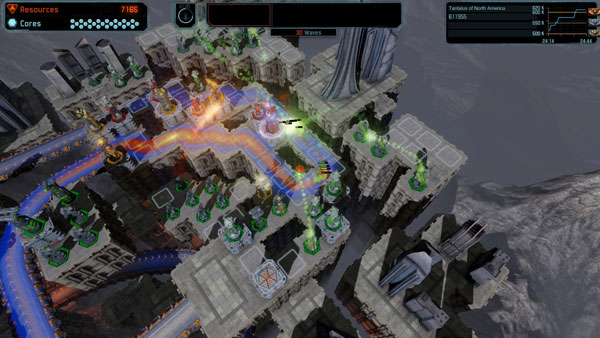
The Defense Grid sequel seems more like an expansion than a new game. There are new powers and customizations, but core game remains the same; build towers and watch them mow down a seemingly endless stream of baddies. In fact, with the new upgrades, I think this may be easier than the original. I suppose the challenge really is in the alternate game modes where you a limited to certain spots or specific towers. Given the choice, I think I prefer the first game and its simple character-study story. This one tries to up the narrative ante by adding several voiced characters, but it just gets confusing and incoherent. The game still works as a casual strategy game that can be played in small doses.
